


This thing haunts a lot of new and experienced runners.
Overstriding.
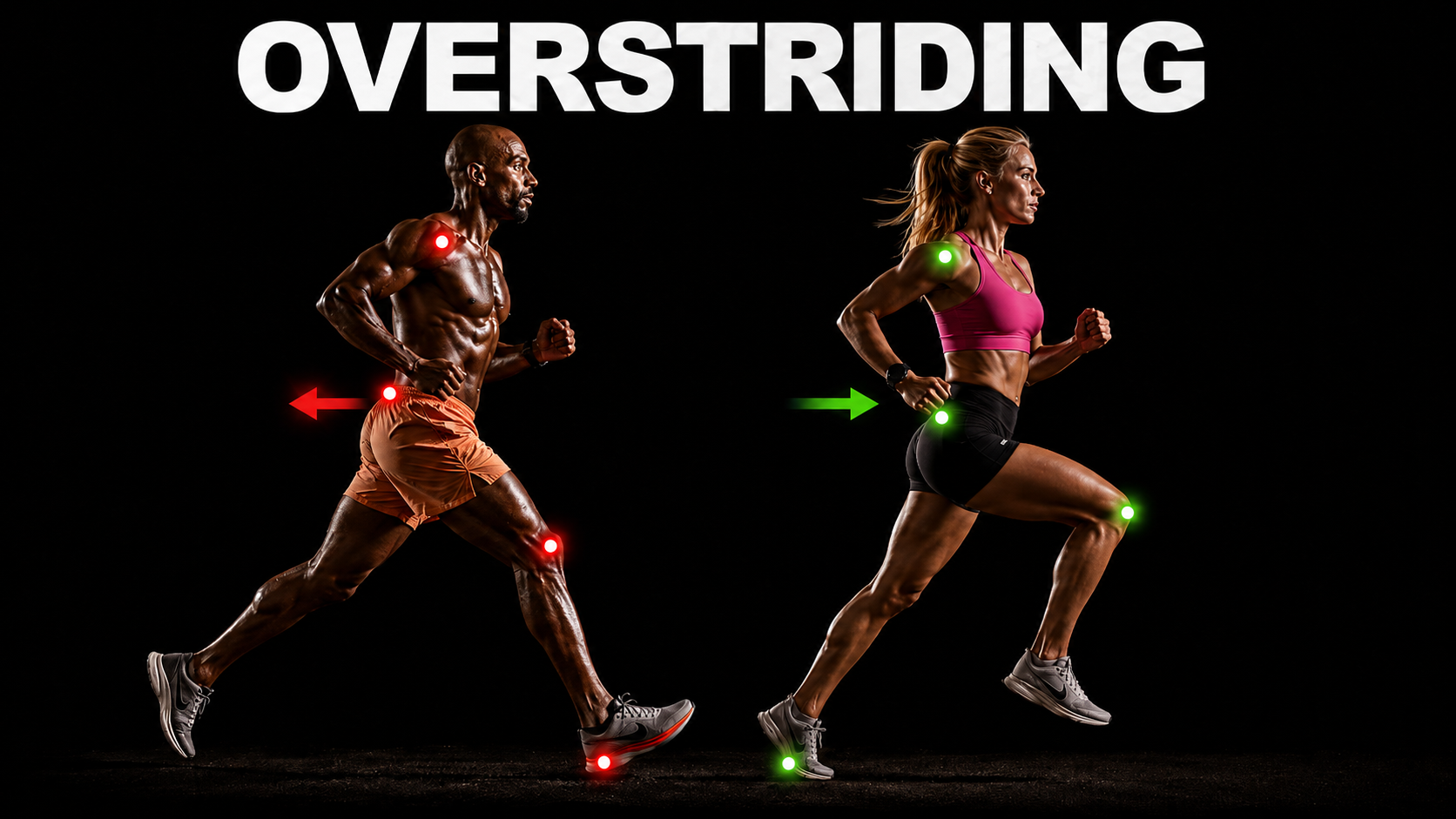
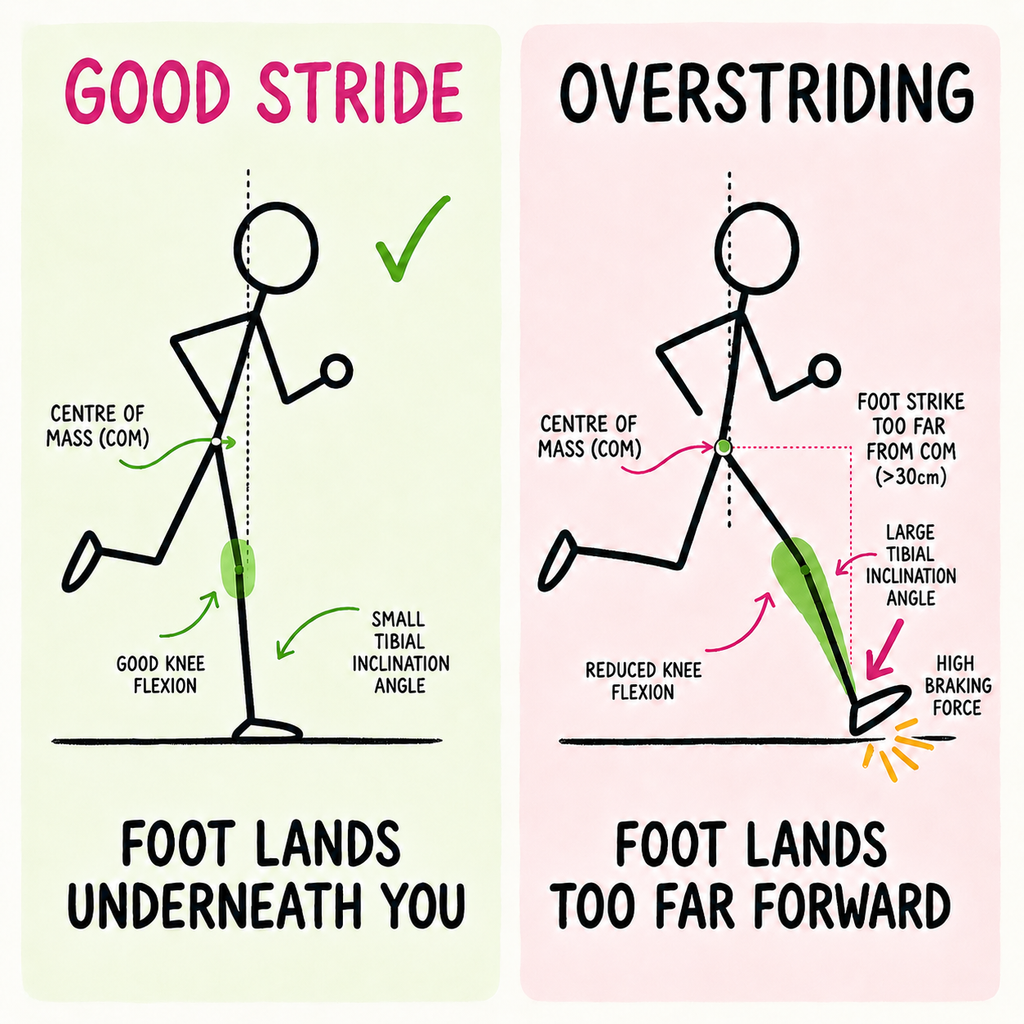
That’s when your foot lands too far out in front of your body, so every step is like driving a car for 1 second then hitting the brakes the other.
Not very efficient and could probably cause damage right?
So what actually fixes it: higher cadence, or shorter steps?
Most runners think they’re the same thing. I did too. But that mix-up is why chasing cadence can make your runs feel harder without fixing the problem.
What You’ll Learn
In this post I’ll go over:
- The two fixes that actually stop your overstriding
- The 30-second hack to run when your heart rate jumps
- The 6-month patience fix that makes the change stick for life
- And exactly what to do this week to start
Two Cues That Fix It
A lot of running coaches say a higher cadence is the fix for overstriding.
And the tricky part is, you can still be overstriding even if your cadence number looks good.
180 steps per minute. Quick feet. Faster turnover. It’s the one of the loud pieces of advice in online running that feels like dogma. I think this is the case because it’s an easy thing to measure, since your watch shows you the number and you can chase it on every run.
But chasing that number on its own is where runners get stuck, because cadence is really just a symptom of good form, not the cause of it. You can force the number up and still be overstriding some of the time.
The real fix for overstriding is two things.
One, shorter steps.
Two, driving your knees up from your hips.
Do those two things and your cadence should climb on its own. Try to force your cadence up without doing them, and you’ll probably just shuffle your feet faster while you keep overstriding.
I was doing between 3:55 and 4:05 per K, which is about 6:30 to 6:45 minutes per mile, and that’s quite fast. I can run a 10K in about low 17 minutes. I think around that time I could run it in, uh, high 16s. So running that pace felt slow. I was in my low zone three heart rate, which is not very high for me to be doing a half marathon.
And just looking at that video really made me go, wow, like I am still slightly over-striding, but I’m running fast.
I was running about 178 to 182 steps per minute, which I thought was high, but obviously wasn’t high enough, and I also wasn’t driving my knees.
Picture it like this. You’re climbing a ladder. Your knee comes up first, and then your foot lands on the rung right under your body. You’d never reach your foot way out to a rung far in front of you, because that’s a great way to fall off. Now tilt that ladder forward. That’s what good knee drive looks like when you run. Knee up, foot down, foot landing under your body, not way out in front, which is exactly what overstriding is.
Want to feel the difference right now, even sitting there? Stand up and march in place a few times, driving one knee up toward your chest and letting that foot drop straight down under your hip. That little drop, with your foot landing under a bent knee, is the feeling you’re after. Now do the opposite and reach a foot way out in front of you with a straight leg, and notice how you’d have to slam down onto your heel to land out there. That’s overstriding. Your body already knows the difference, you just have to teach it to pick the first one while you run.
Shout out to YouTube running coach therapist James Dunne. His take on it is that when runners don’t drive their knees up enough, they end up reaching with the foot to hit the pace they want, and that reach is what turns into overstriding.
There’s actually a Harvard study by Daniel Lieberman that breaks this down perfectly. He found that two runners can take the exact same length step, but one reaches the foot out ahead with a straighter knee while the other drives the knee up so that same foot lands under a bent knee, and the one reaching with the straighter knee takes a way bigger pounding on impact with every step.
This is Sabastian Sawe setting a marathon world record and doing sub 2 hours. Watch his knee come up, and watch where his foot lands. Right under his hip, no overstriding. His cadence is over 180, even at the end of a marathon, and he didn’t get there by counting steps. He got there because his form makes that cadence happen on its own.
So if cadence isn’t the fix for overstriding, how do you actually start training it?
How To Train The Two Cues
It’s almost impossible to think about your form for a whole race, and most runners give up on it after about 3 minutes of trying.
To help with that, I built a free 6 month training plan and cheat sheet. Yeah, you heard that right, 6 months, because this stuff is lifelong, not a quick hack. It handles all the drills, the progression, and the strength work for you. You can get it at the link below. Here are four quick samples of what’s inside.
One, run short uphill strides so your foot lands under your hips.
Two, do barefoot strides on grass to feel a cleaner landing under you.
Three, do A-skips plus a few pogo or lunge jumps to train your knee drive.
Four, train your hip flexors twice a week to strengthen the muscles that drive your knees up. Most runners skip this, and it’s a big reason they keep overstriding without knowing it. I’ll go deeper on this one in a minute.
Alright, now that you’ve got the free plan, let’s get into the two walls that stop most runners from fixing this.
Wall To Overcome #1: Sort The High Heart Rate Thing
Your heart rate is the first wall you’ve got to get over, so you can stop overstriding and start running faster and farther with less effort.
Here’s what happens to so many runners I coach. They bump their cadence up 5, 10, even 20 steps a minute to fix their overstriding. Then their heart rate is 15 beats higher than it was on the same easy run they do every Wednesday. They figure the high-cadence thing is broken, they give up, and they go right back to their old form, still overstriding.
Here’s what actually happened.
Running speed equals cadence times stride length. That’s the equation. If you bumped your cadence up but didn’t shorten your stride at the same time, you’re now running faster than you used to. Your heart rate went up because you sped up, not because cadence is bad for you.
And you’re probably still overstriding underneath, because the faster pace just hides what your form is doing.
So don’t add steps. Shorten your stride first, drive your knees up, and your cadence will rise because the math says it has to. You’re covering less ground with each step at the same speed, so you need more steps to hold that speed, and your heart rate should stay where it was because your pace stayed where it was.
Now, running with shorter steps does use a little more energy at first, so your heart rate might sit slightly higher for a bit. That’s temporary. Your body adapts and it stops feeling like extra work, as long as you do the drills from the plan a few minutes before two or three runs a week. That’s it.
Here’s the 30-second hack for the heart rate problem. On your next easy run, glance at your watch and note your pace and your heart rate. Then, without speeding up at all, take quicker, lighter, shorter steps for 30 seconds, like the ground is a little too hot to stand on, and hold your pace exactly the same. If your heart rate stays about where it was, perfect, you shortened your stride the right way. If your pace jumped, you added steps without shortening, and that’s the exact mistake we’re fixing. Reset and run it again. That’s the whole test.
Quick run science nerd break. A landmark 2011 study by Heiderscheit and his team found that bumping your step rate up by 5 to 10 percent cuts your braking forces, lowers the energy your hips and knees have to absorb, and shortens your step length.
So if you can get over that first wall, what’s the second one?
Wall To Overcome #2: Give It Time
Wall number two is the one that takes most runners out, and that’s patience.
Real talk, this is exactly how I learned all of this.
Late last year, coming out of my marathon training, my hip started flaring up and my lower back was always kind of sore. So I spent the next 8 months trying to fix it with stretching and strengthening, but the stretching only helped for a few hours after I did it, and the strengthening wasn’t doing much because I was strengthening all the wrong stuff.
I thought my form was solid. I’d been running 180 to 182 cadence for years, which seemed totally fine, and I was sure I wasn’t overstriding because my numbers looked good on the watch. Then I went and saw a physio, and he took one look and told me my front hip flexors were really weak, and that I’d never actually targeted them with my strength work. Which is kind of crazy when you think about it, because I’ve done almost every hip and glute exercise in the gym trying to fix this.
Once I started actually strengthening those hip flexors and paying attention to my knee drive, I figured out something nobody talks about, and it’s a big one.
Your cadence naturally changes depending on how fast you’re running, and that’s totally normal. When I’m doing strides or sprinting, I can hit 190 plus steps a minute pretty easily, because that’s just what happens when you move fast and your legs turn over quicker. But when I’m grinding through a slow zone 1 easy run, hitting 190, or even 180, is basically impossible, and forcing it would wreck the whole point of an easy run.
Every runner has their own cadence range based on their speed, and your easy-run range will always sit lower than your fast-run range, which is totally normal. The problem is that most of your running, usually 70 to 80 percent of it if you train more than 4 hours a week, happens at an easy or moderate pace. That’s true for most amateur marathoners running 5 hours or more, and for half, 10K, and even 5K runners too, because almost nobody holds that pretty 100-meter sprint form for a whole race.
And that easy, moderate pace is exactly where your cadence drops the most, so it’s exactly where overstriding sneaks in without you noticing.
So what I started doing was nudging the bottom of my range up a bit. My easy runs used to sit around 176 to 180 steps per minute, and I slowly pushed them up to about 182 to 185, depending on how I feel that day. On my faster runs I bumped them up to 186 to 188 spm.
All of this took me 8 months to figure out. So if you’re 3 months into your own fix and it’s not clicking yet, you’re not behind. You’re right on schedule.
Patience Is The Real Hack
This is why you should manage your expectations about fixing your overstriding, because it might take 6 to 12 months, not 6 weeks. Your body is learning a brand new movement pattern, and the muscles, tendons, and ligaments that have been firing the old way for years, some of you for decades, need real time to adapt.
Month 1 might feel worse. Month 3 starts to click. Month 6, you’re a different runner. James Dunne calls this minimum effective change, and his point is that if you change your form too fast, you’ll just uncover new weak spots and probably get hurt.
Your form actually changes pretty fast, but your body needs weeks and months to catch up to it, and that lag is exactly what feels like failure if you don’t know it’s coming.
That’s patience in a nutshell, and patience is actually a whole section of the book I’m working on. It’s called 1% Better Runner, and it’s about the mental skills you need to get a little better every day and live a dope running life as a regular person with a job, a family, and way too much going on. You can get early access at the link below.
Alright, you know the fix and you know the two walls. So where does that leave you?
LINKS, LEARNINGS & STUDIES REFERENCED
- Heiderscheit et al., 2011 step rate study https://pubmed.ncbi.nlm.nih.gov/20581720/
- Daniel Lieberman’s Harvard study on reaching the foot out https://www.nature.com/articles/nature03052
- The 1% Better Runner Book (early access): https://dlakecreates.com/bookaccessyt
- Run Form Master Class: https://dlakecreates.com/running-form-fixes/
- A Skips video: https://dlakecreates.com/askips
- Instagram – https://instagram.com/dlakecreates
- Strava – https://www.strava.com/athletes/120507


